Dry bulk shipping is often associated with scale. Massive vessels, high tonnage, and continuous throughput define the category. But in practice, capacity alone is not what keeps cargo moving efficiently. Precision is what separates reliable operations from costly delays.
At ports like the Port of Lake Charles, dry bulk logistics are not simply about handling volume. They are about controlling every step of the process, from vessel arrival to final inland distribution.
The Misconception About Bulk Cargo
There is a common assumption that dry bulk cargo is easier to manage than containerized freight. After all, it is unloaded in large quantities and often stored in open areas. In reality, dry bulk operations require a high level of coordination.
Different materials behave differently. Cement must be kept dry and protected. Aggregates require efficient staging and movement. Fertilizers and minerals may have handling or environmental considerations. Each commodity introduces its own operational requirements.
Without precision in handling, scheduling, and storage, small inefficiencies can quickly compound into delays across the entire supply chain.
Where Precision Matters Most
Dry bulk logistics rely on timing and coordination across multiple systems. At the Port of Lake Charles, this includes vessel scheduling, berth availability, equipment readiness, and labor coordination.
Even minor disruptions can impact throughput. A delay in unloading can affect rail scheduling. A bottleneck in storage can slow down truck loading. These are not isolated issues. They are interconnected.
Precision ensures that cargo continues moving without interruption. It allows operators to maintain flow rather than react to problems after they occur.
Infrastructure Is Only Part of the Equation
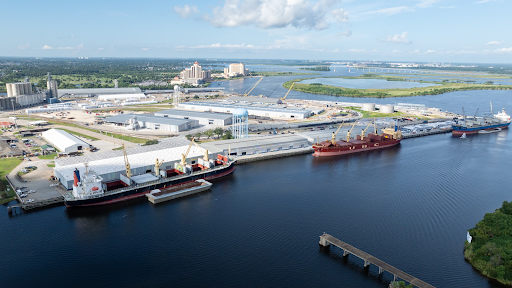
The Port of Lake Charles offers the physical capacity needed for large-scale dry bulk operations. With over a mile of contiguous berthing and significant laydown space, the Port is built to handle volume.
But infrastructure alone does not guarantee efficiency.
Operational planning, experienced personnel, and coordinated logistics systems are what turn that capacity into performance. The ability to move cargo seamlessly between vessel, barge, rail, and truck depends on how well each piece of the operation is aligned.
Multimodal Coordination Drives Efficiency
One of the defining advantages of the Port of Lake Charles is its multimodal connectivity. Access to the Calcasieu Ship Channel, the Gulf Intracoastal Waterway, major rail carriers, and interstate highways allows cargo to move in multiple directions with flexibility.
This flexibility, however, increases the need for precision.
Coordinating between transportation modes requires accurate timing and communication. Railcars must be available when cargo is ready. Trucks must be scheduled to avoid congestion. Barges must align with vessel operations.
When executed correctly, this coordination reduces dwell time and improves overall supply chain performance.
Supporting Industry Through Reliable Movement
Dry bulk cargo supports critical industries across Louisiana and beyond. Construction, energy, manufacturing, and agriculture all depend on consistent material flow.
The Port of Lake Charles plays a key role in maintaining that consistency. By focusing on precision in logistics, the Port helps reduce disruptions and supports ongoing industrial activity throughout the region.
Precision Is the Real Advantage
In dry bulk shipping, scale will always matter. But it is precision that ensures reliability.Ports that prioritize coordination, timing, and operational control are better equipped to handle growing demand and shifting market conditions. At the Port of Lake Charles, that focus on precision is what keeps bulk cargo moving efficiently across the Gulf Coast and into global markets.